

DC Power & Battery Monitoring
Victron equipment for the DC side of a power system — isolated conversion, auxiliary charging, solar charge control and proper state-of-charge measurement.
DC conversion, charging and monitoring
Victron equipment for the DC side of a power system: isolated DC-DC converters that step 48 V down to 24 V or 12 V for control and instrumentation, a DC-DC charger for auxiliary batteries, MPPT solar charge controllers, and the SmartShunt battery monitor.
These pair naturally with the sodium-ion batteries and storage systems we supply. The SmartShunt in particular is the difference between guessing at state of charge and measuring it, and it reports over Bluetooth without adding a panel.
See also our next-generation battery solutions.
Advantages of Victron DC Equipment
The DC side of a power system decides whether the controls stay up and whether you know how much battery is left. These are the parts that do both.
Isolated conversion
The Orion-Tr 48/12 and 48/24 converters give a clean, isolated 12 V or 24 V rail from a 48 V bank for controllers, telemetry and instruments.
Measured state of charge
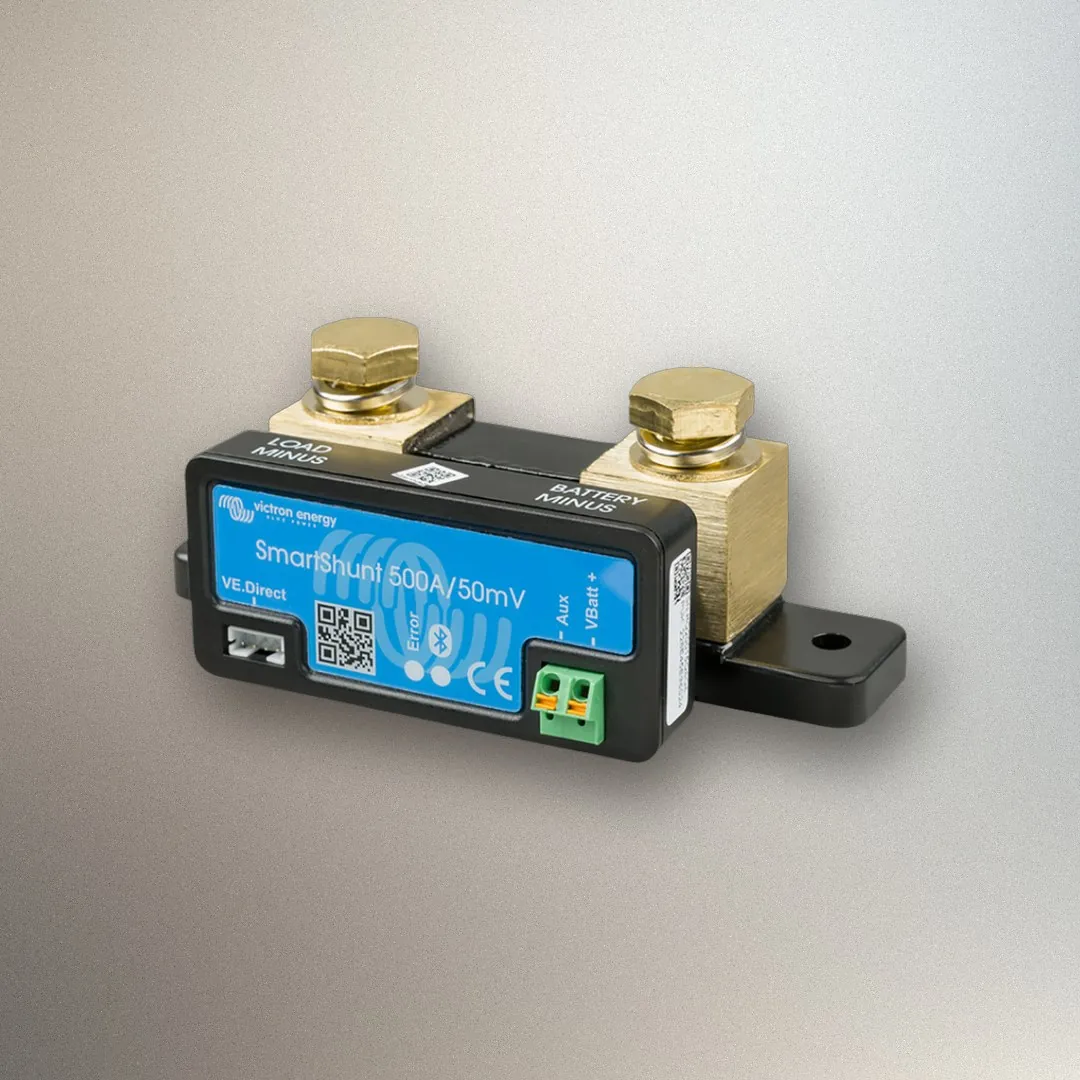
The SmartShunt 500A measures current through the battery and reports state of charge to a phone over Bluetooth, instead of guessing from voltage.
Solar and auxiliary charging
SmartSolar MPPT controllers charge from panels, and the Orion-Tr Smart charges a 24 V auxiliary battery from a 12 V source, both set up in the VictronConnect app.
Key Features
- Orion-Tr isolated DC-DC converters, 48 V to 12 V (9 A) and 48 V to 24 V (5 A)
- Orion-Tr Smart 12/24-10A three-stage DC-DC charger with Bluetooth
- SmartShunt 500A battery monitor, Bluetooth, no panel display needed
- SmartSolar MPPT 75/10, 100/30 and 100/50 solar charge controllers


DC Power and Battery Monitoring FAQ
The converters, the Orion-Tr 48/12-9A and 48/24-5A, take a 48 V bank down to a steady 12 V or 24 V rail for controls, instruments and accessories, with galvanic isolation between input and output. The Orion-Tr Smart 12/24-10A is a charger: it takes a 12 V input from a starter battery or alternator and steps it up to charge a 24 V auxiliary battery through a three-stage profile, and it works behind a smart alternator.
Galvanic isolation keeps the input and output circuits separate, so a fault, a ground loop or noise on the 48 V side does not reach the 12 V equipment. On a control panel fed from a battery bank, that is the reason to use an isolated converter rather than a plain regulator.
Add up the current of what runs on the output rail, then pick the converter with headroom. The 48/12-9A gives 9 A at 12 V (110 W) and the 48/24-5A gives 5 A at 24 V (120 W). If your rail needs more than that, send us the load list.
It sits in the negative lead and measures the current in and out of the battery, then reports state of charge, time to go, voltage, current and history to your phone over Bluetooth through the VictronConnect app. There is no display on the unit and nothing to mount on a panel. It handles up to 500 A.
Match the controller to the panel array. The 75/10 suits a small array; the 100/30 and 100/50 take a larger array and higher charge current. The first number is the maximum panel voltage the controller accepts and the second is the maximum charge current in amps, so add up the panel open-circuit voltage and the array current before choosing. Send us the panel specifications and the battery bank if you would like us to check.
They are the DC-side equipment we pair with them. The SmartShunt gives a measured state of charge on the bank, and the converters and chargers run the 12 V and 24 V loads from it. See our batteries and battery storage systems pages for the banks themselves.

Talk to an engineer
Have questions or need assistance? Our team is ready to help you via email, phone, not a chatbot.
Latest Blogs


Our team is ready to help!
If you have any questions, need further information, feel free to reach out, and we'll get back to you as soon as possible. We look forward to hearing from you!